Overview
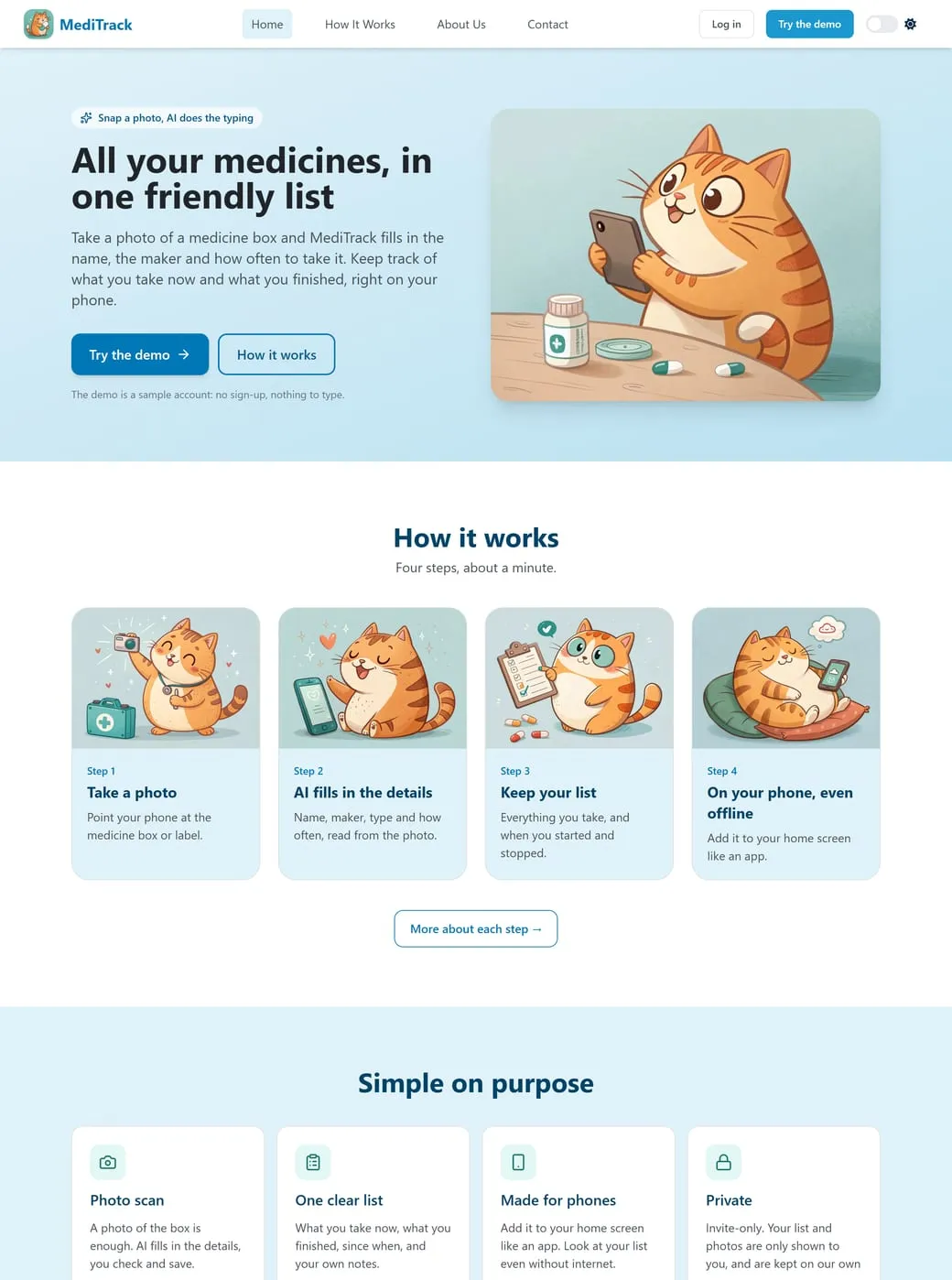
MediTrack keeps one simple list of your medicines: what you take now, what you have finished, when you started and stopped, and your own notes.
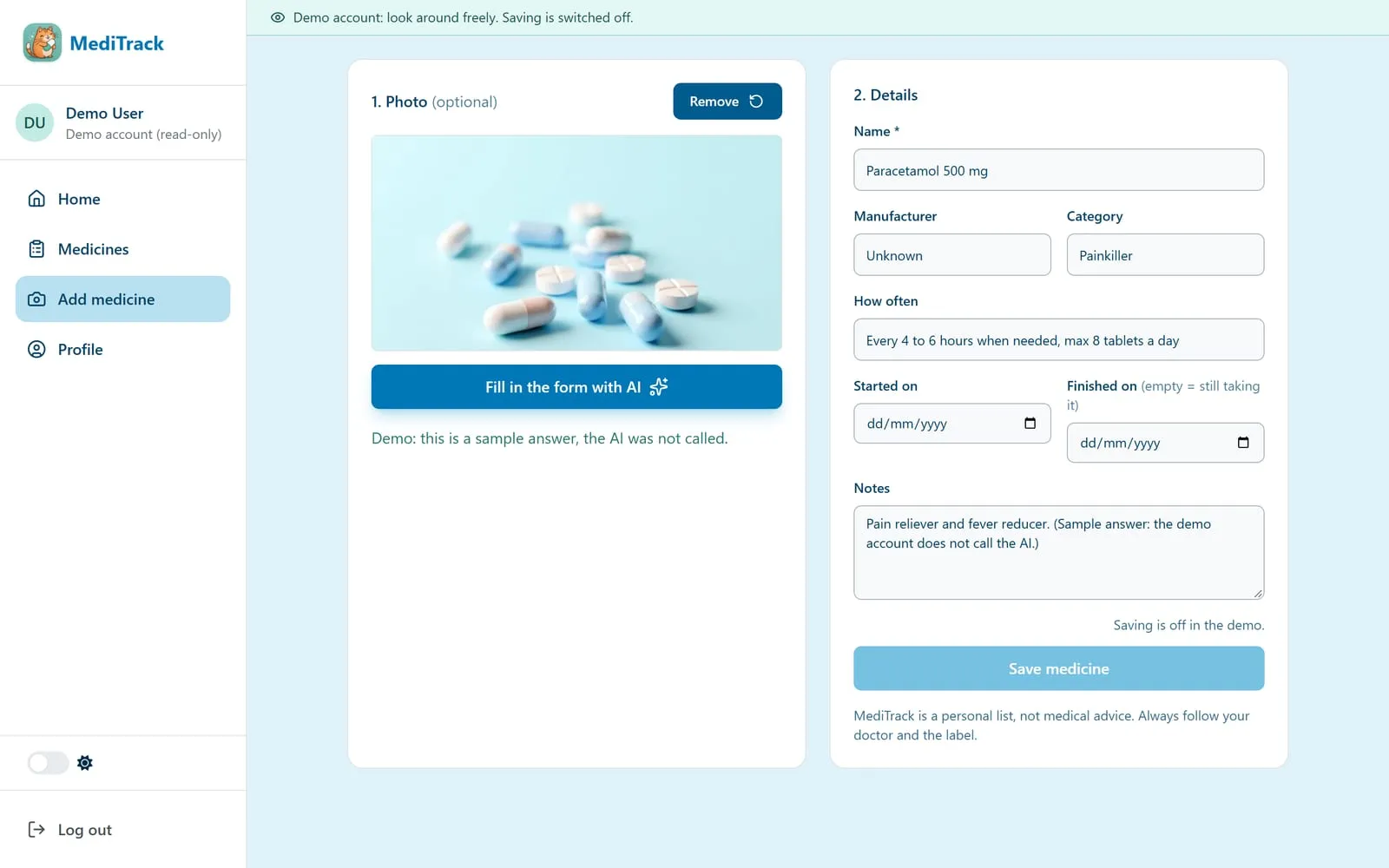
Adding one is a photo. Point your phone at the box or label, and AI reads the name, the maker, the type and how often to take it, and fills in the form. You check it and save. Nothing is saved without you looking at it first.
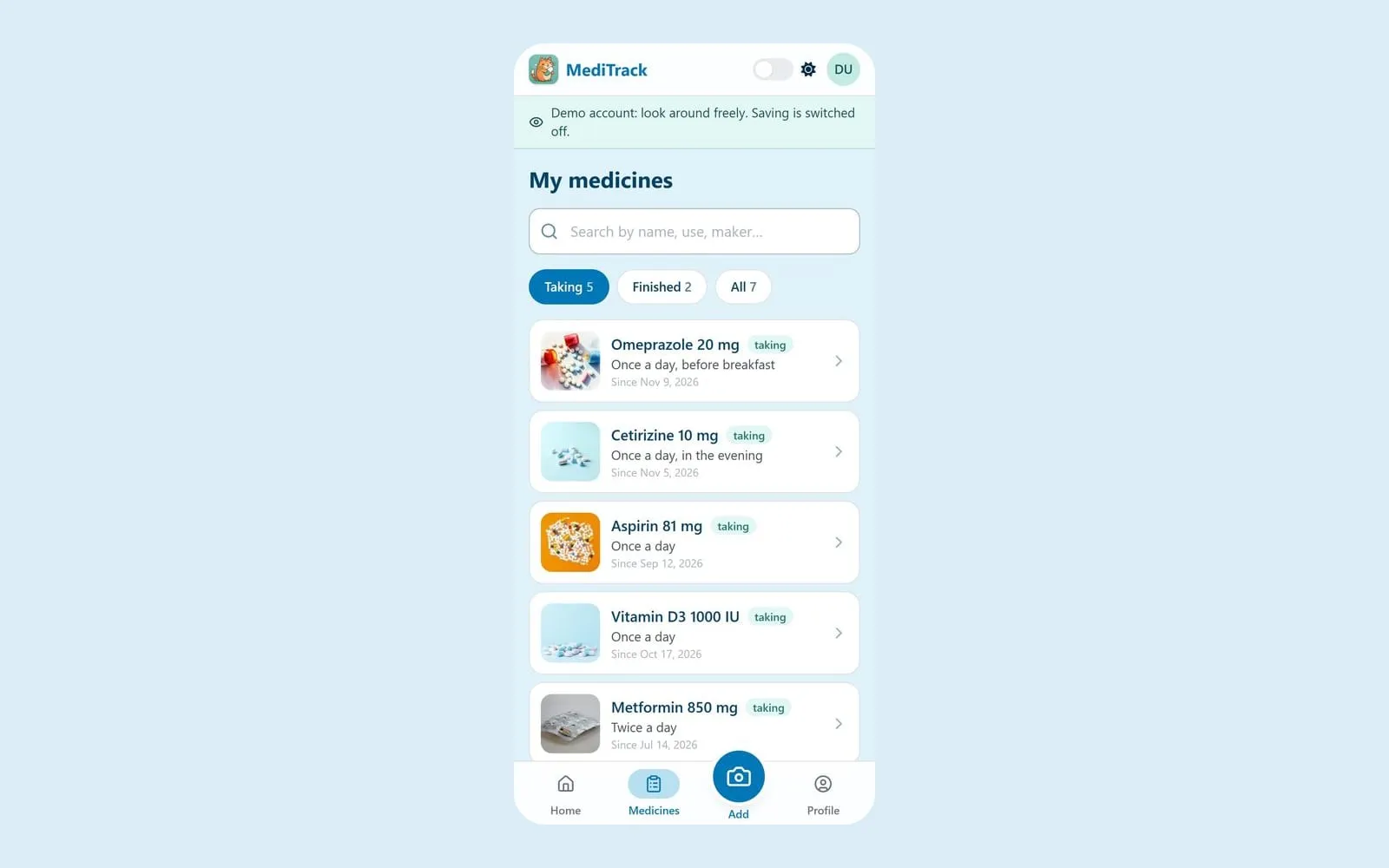
It is made for phones. You can add it to your home screen like an app (it is a PWA, a website that installs like an app), and your list still opens without internet.
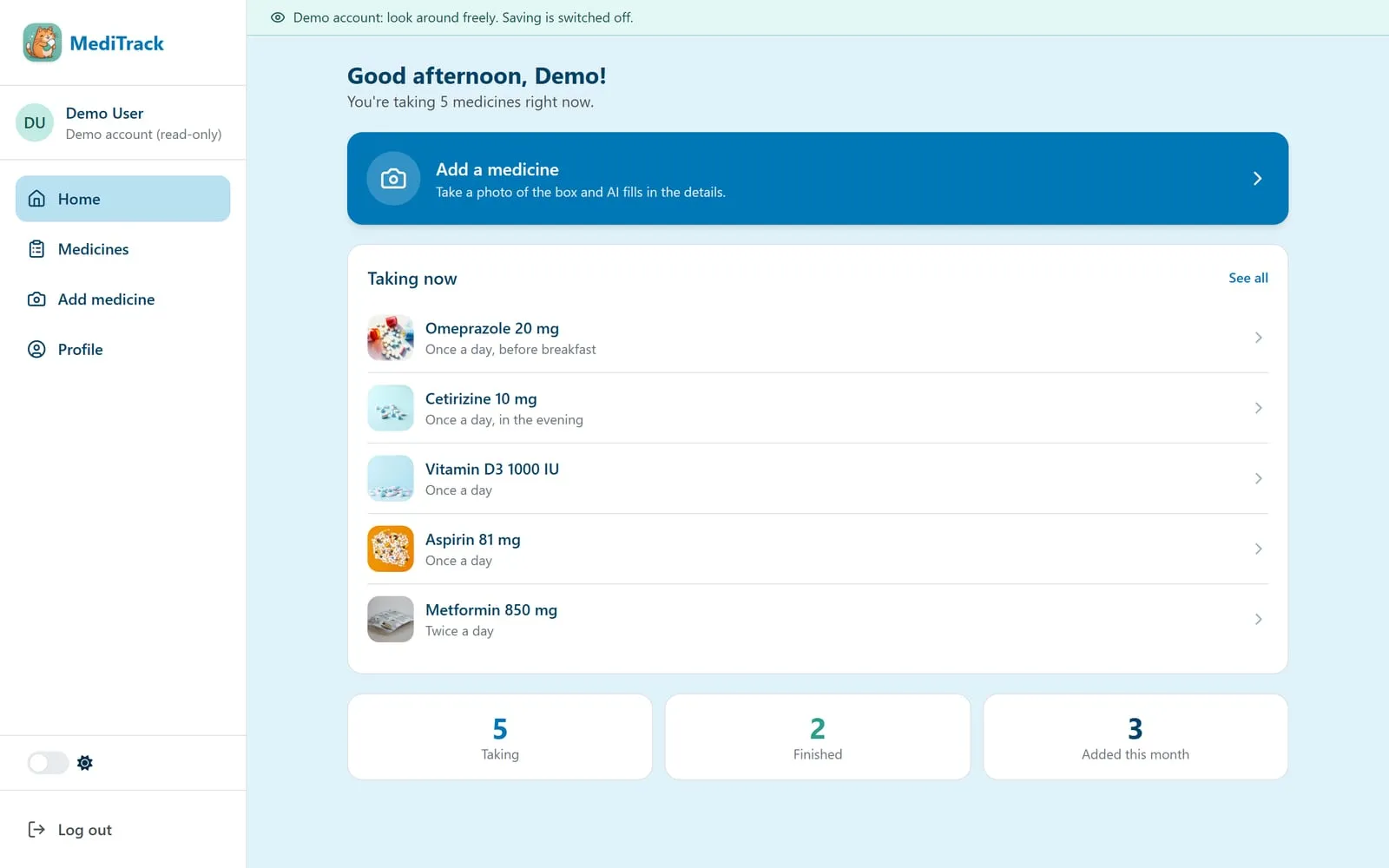
Try it: the “Try the demo” button opens a sample account with a medicine list and the dashboard. No sign-up, nothing to type. The demo can look at everything but cannot change anything or call the AI.
Features
- Photo scan: the AI fills in the details, you check and save
- One clear list: current and finished medicines, dates and notes
- Installs on a phone with its own icon, and opens offline to read the list
- Invite-only: there is no public sign-up. The admin invites someone by email, and they set their own password from the link
- A read-only demo account that always shows fresh dates, so it never looks old
- Private by design: each user sees only their own medicines, and a medicine photo is shown only to its owner
Tech Stack
- SvelteKit 2 and Svelte 5, in TypeScript, running as a Node server
- Tailwind CSS 4
- PostgreSQL on my own server, for the data and the logins
- Claude Haiku 5.5 (Anthropic’s API) to read the photos, at about $0.0002 a scan
- Its own login system: passwords stored with scrypt (a hashing method made to be slow to guess), sessions, and email links for invites and resets
- Docker (each app runs in its own sealed box) with memory and CPU limits, shipped by GitHub Actions
The rebuild
The 2025 version ran on Vercel, with Supabase for the database, the logins and the photos, Google login, and OpenAI reading the pictures. It worked, but it had real holes: the AI address could be called by anyone, so a stranger could spend my API key, and the medicine photos (health data) were public.
In November 2026 I rebuilt it. I worked with Claude Code (an AI coding assistant) on it: I set the plan and checked every change.
- Off third-party services. Data, logins and photos all live on my own server now. No Supabase, no Google login, no Vercel.
- It cannot run up a bill. Every scan is counted in the database, so a restart does not reset the count: 10 a day per user and 50 a day for the whole site. The demo gets a ready-made sample answer and never calls the AI.
- Logins that resist guessing. Five wrong passwords lock an account for 15 minutes, and “forgot password” answers at the same speed for every email, so it does not reveal who has an account.
- Attacked on every push. A test script starts the built app and attacks it: logins, the demo’s read-only rule, other users’ data, the AI limits. It runs 48 checks on GitHub before anything reaches the server. A security review on 12 Nov closed a login redirect trick (a link that would send you to an outside site after logging in) and made the email check stricter.
Outcome
- A small, honest app anyone can try in a minute, and real users can rely on
- Health data that stays private, on a server I control
- No hosting bill beyond the server I already run, and no way for a visitor to run up the AI bill